
Residential & Commercial
Orlando Concrete Contractors for Driveways, Patios, Pool Decks, Slabs & More
Concrete for homes and businesses across Orlando and Central Florida — from driveways and pool decks to parking areas and warehouse floors. New installation, plus repair, resurfacing and leveling.
Free estimates. A real number, not a guess over the phone.
- Installation
- Repair
- Replacement
- Resurfacing
- Licensed & Insured
- Residential & Commercial
- Concrete Installation
- Concrete Repair & Replacement
- Orlando & Surrounding Areas
Residential Concrete
Concrete work for your home and yard
The flat work around a house takes the most weather and the most wear. Whether you are pouring a new driveway, adding stamped concrete to a patio, or need concrete leveling for a sinking slab, here is where most homeowners start.
Driveways
New driveway installs and full replacements, planned around your slope, drainage and daily vehicle traffic.
Patios
Back patios, extensions and outdoor living slabs sized to how you actually use the space.
Pool Decks
Pool decks built for Florida sun, bare feet and constant water exposure, in a range of finishes.
Walkways & Sidewalks
Entry walks, side paths and connecting walkways poured to a consistent, even surface.
Slabs
Shed pads, A/C pads, hot tub bases, garage floors and other flat work around the property.
Repair & Replacement
Cracking, spalling, settling or uneven concrete — repaired where it makes sense, replaced where it does not.
Decorative & Stamped
Stamped patterns, stained color and finish options for driveways, patios and pool decks.
Resurfacing
Driveway resurfacing, overlays and refinishing that change the look and surface of concrete that is still sound underneath.
Leveling
Sunken or uneven slabs lifted back to level and stabilized with polyurethane foam injected underneath, without tearing out the existing concrete.
Not sure which one your project falls under?Tell us what you are looking at
Commercial Concrete
Concrete for properties that have to stay open
Parking areas, walkways, pads and floors take constant traffic, and the work has to be planned around tenants, customers and deliveries. We scope commercial projects around keeping as much of the property usable as possible.
Commercial Slabs
Flat work and structural slabs for new build-outs, expansions and replacement of failed sections.
Parking Areas
Concrete parking areas and lot sections, scheduled to keep as much of your property usable as possible.
Sidewalks & Walkways
Public-facing walkways and connecting paths, including uneven sections that have become a trip hazard.
Curbs & Gutters
Curbing, gutter lines and islands that direct traffic and move water off the property.
Dumpster & Equipment Pads
Pads built for concentrated weight, heavy pickup traffic and daily wear.
Loading Areas
Loading zones, approach slabs and dock aprons that take repeated heavy truck traffic.
Repair & Replacement
Damaged, settled or failing commercial concrete assessed for repair, resurfacing or full replacement.
Warehouse & Industrial Floors
Interior floors and slabs for warehouse, distribution and light industrial spaces.
Property managers, general contractors and business ownersSend us the scope
Why work with us
Straight answers, and a plan before anyone breaks ground
Most complaints about concrete work are not really about concrete. They are about not knowing what was going to happen, or finding out too late that the plan did not fit the property. That is the part we take seriously.
You hear the plan before we pour
Scope, materials and sequence get explained in plain language before any work starts. You should never be guessing what happens next on your own property.
The job gets planned around your site
Access, slope, drainage, existing structures and where water already goes all shape how a pour should be laid out. We look at those first, not after.
The right approach for the work
A shed pad, a pool deck and a loading area are not the same job. We match the approach, thickness and finish to what the concrete actually has to do.
Built for how the space gets used
Foot traffic, vehicle weight, pool chemicals and delivery trucks all wear concrete differently. How a slab will be used drives how it gets built.
Recommendations specific to your property
No two Orlando properties drain, settle or sit the same way. You get a recommendation for the concrete in front of us, not a standard package.
Residential and commercial work
Driveways and patios for homeowners, parking areas and warehouse floors for property owners and managers. Same crew standards on both sides.
Repair or replace
Not every crack means you need a new slab
Some concrete can be repaired or resurfaced and get years more out of it. Some concrete is past that, and patching it just delays the same bill. Here is roughly how the two cases tend to look.
Repair may make sense when
- Cracking is limited to the surface rather than running through the slab
- Damage is isolated to one section instead of spread across the whole pour
- The slab is still sitting level, with no sinking or lifted edges
- The base underneath appears stable and is draining
- The concrete is structurally sound and the concern is mostly how it looks
Replacement may be the better call when
- Cracks are wide, deep, or spreading across multiple sections
- Parts of the slab have settled, sunk, or lifted to different heights
- The same damage keeps coming back after previous patch work
- The base underneath has washed out, shifted, or never drained properly
- The concrete has reached the end of a long service life
Central Florida conditions
What Orlando does to concrete
Concrete here lives through a long rainy season, months of direct sun and ground that does not behave the same way it does further north. These are the conditions worth planning around before a pour, not after.
- Rainfall
A wet season with real dates
Central Florida’s wet season runs roughly from late May into the middle of October, and most of the year’s rain arrives inside that window — often as heavy afternoon storms rather than steady rain. It shapes when work gets scheduled, and it means concrete that sits where water collects tends to show it sooner than concrete that sheds water away.
- Drainage
Where the water actually goes
Slope and drainage are part of the concrete plan, not an afterthought. Standing water against a slab edge, or runoff pushed toward a foundation, causes problems that no finish will hide.
- Heat
Summer heat during placement
High temperatures affect how quickly concrete sets up while it is being placed and finished. Orlando summer pours need to be planned around the heat rather than worked straight through it.
- UV
Year-round sun exposure
Constant sun is hard on color, sealers and decorative finishes over time. It is worth knowing up front how a given finish tends to hold up outdoors here.
- Humidity
Moisture in the air and ground
Humidity affects curing conditions and contributes to surface staining and growth on shaded concrete. It is a normal part of working in this climate and gets planned for.
- Soil
Sandy and variable site conditions
Sandy soils are common across Central Florida, and conditions can change from one side of a property to the other. What goes under the slab matters as much as the slab itself.
- Outdoor living
Pools, patios and bare feet
Pool decks deal with splash-out, pool chemicals, sun and people walking on them barefoot. Those spaces get treated differently than a driveway that only has to carry vehicles.
What we pour
The concrete work we take on across Orlando
Concrete is easier to judge with your eyes than with adjectives. These illustrations show the kind of work we do — driveways, pool decks, stamped patios, commercial slabs and sidewalks — so you can see what a finished surface looks like before you call.
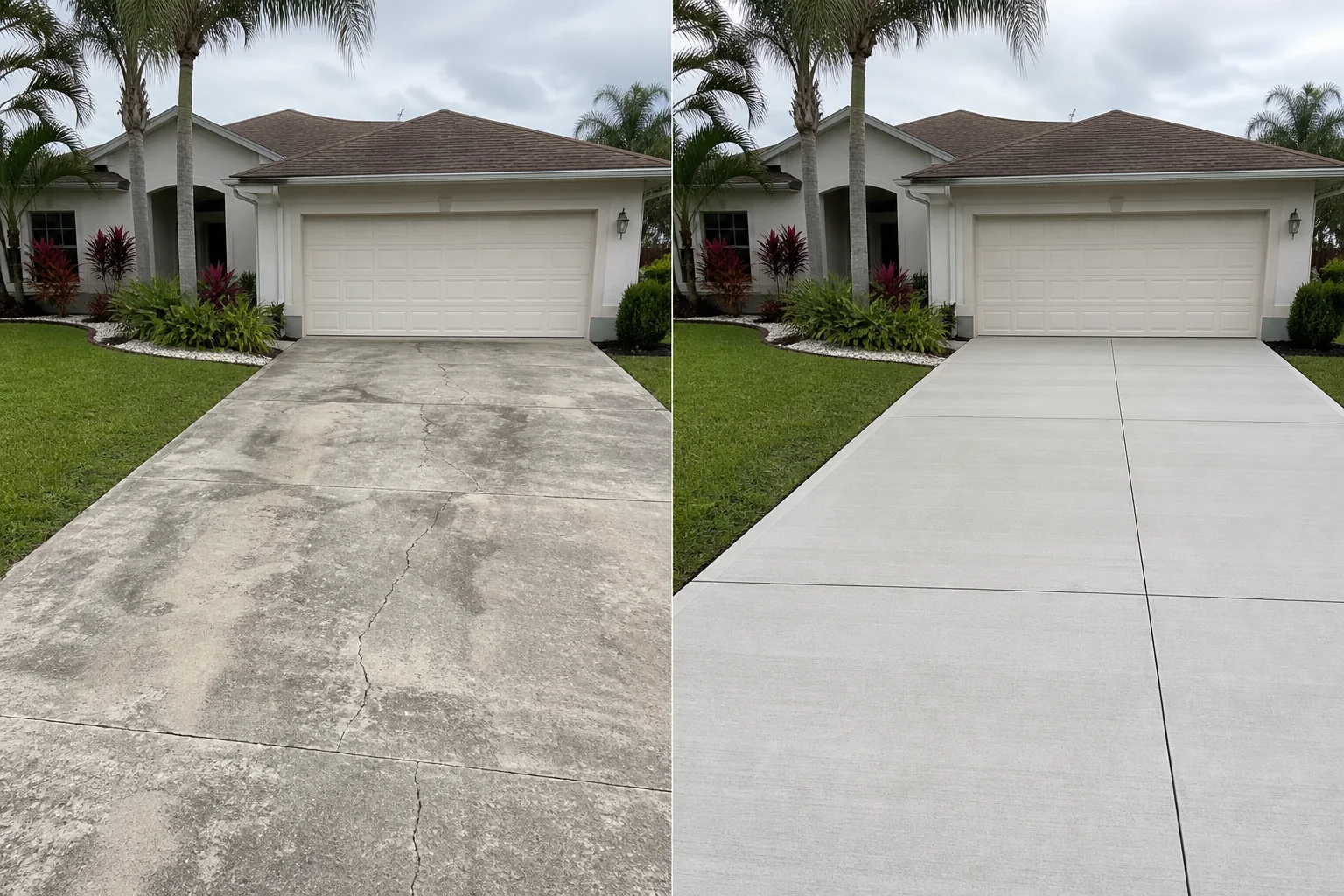
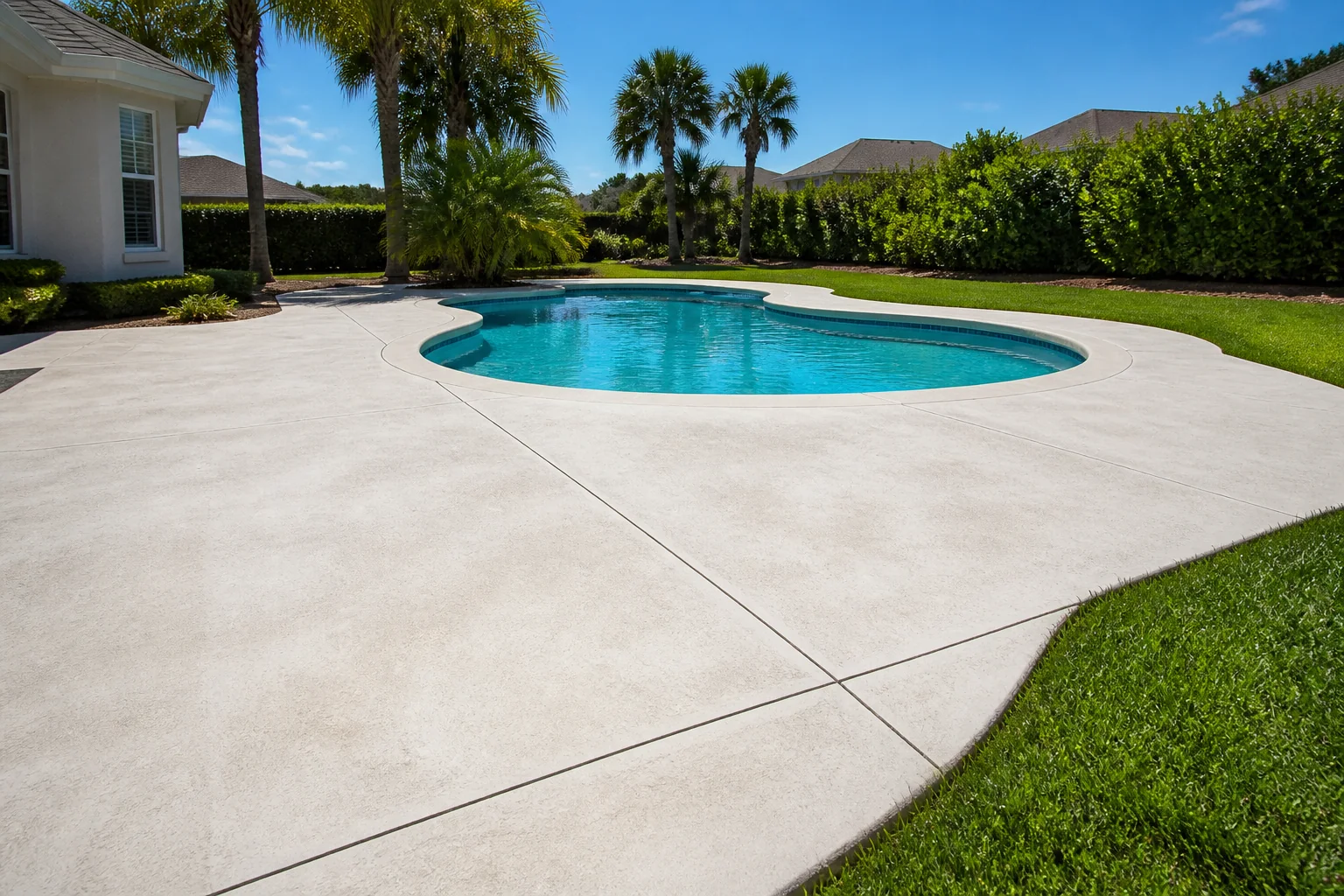
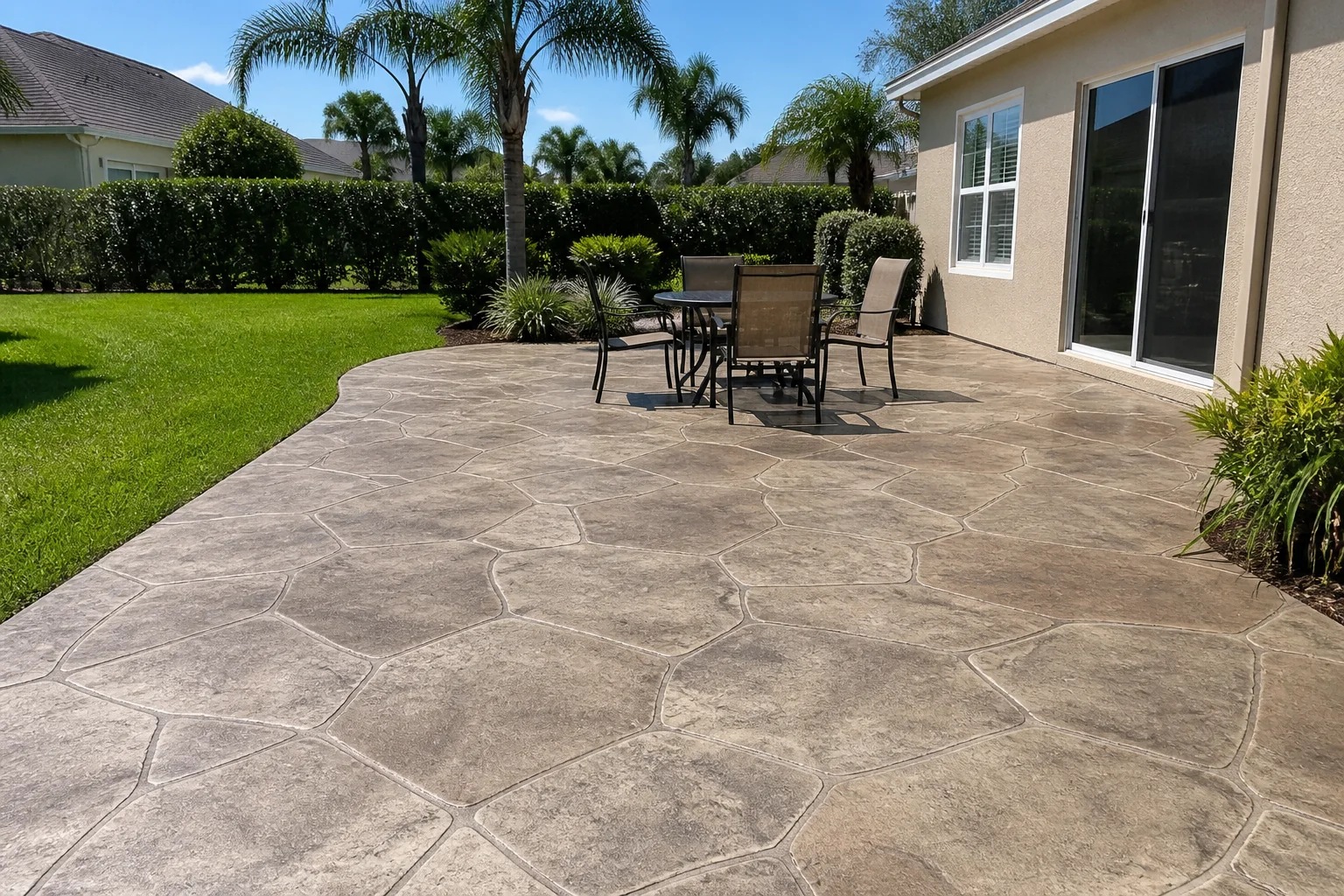
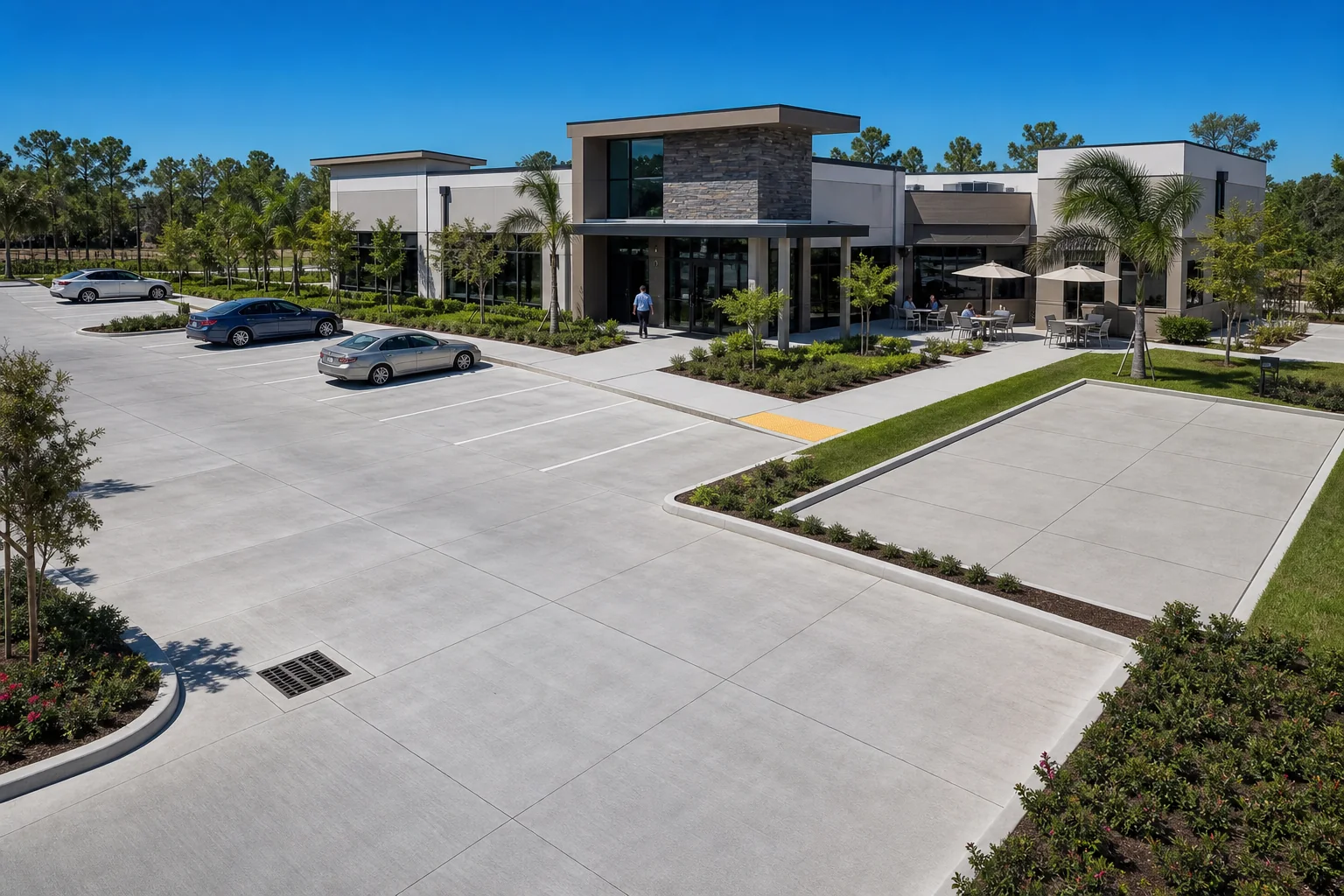
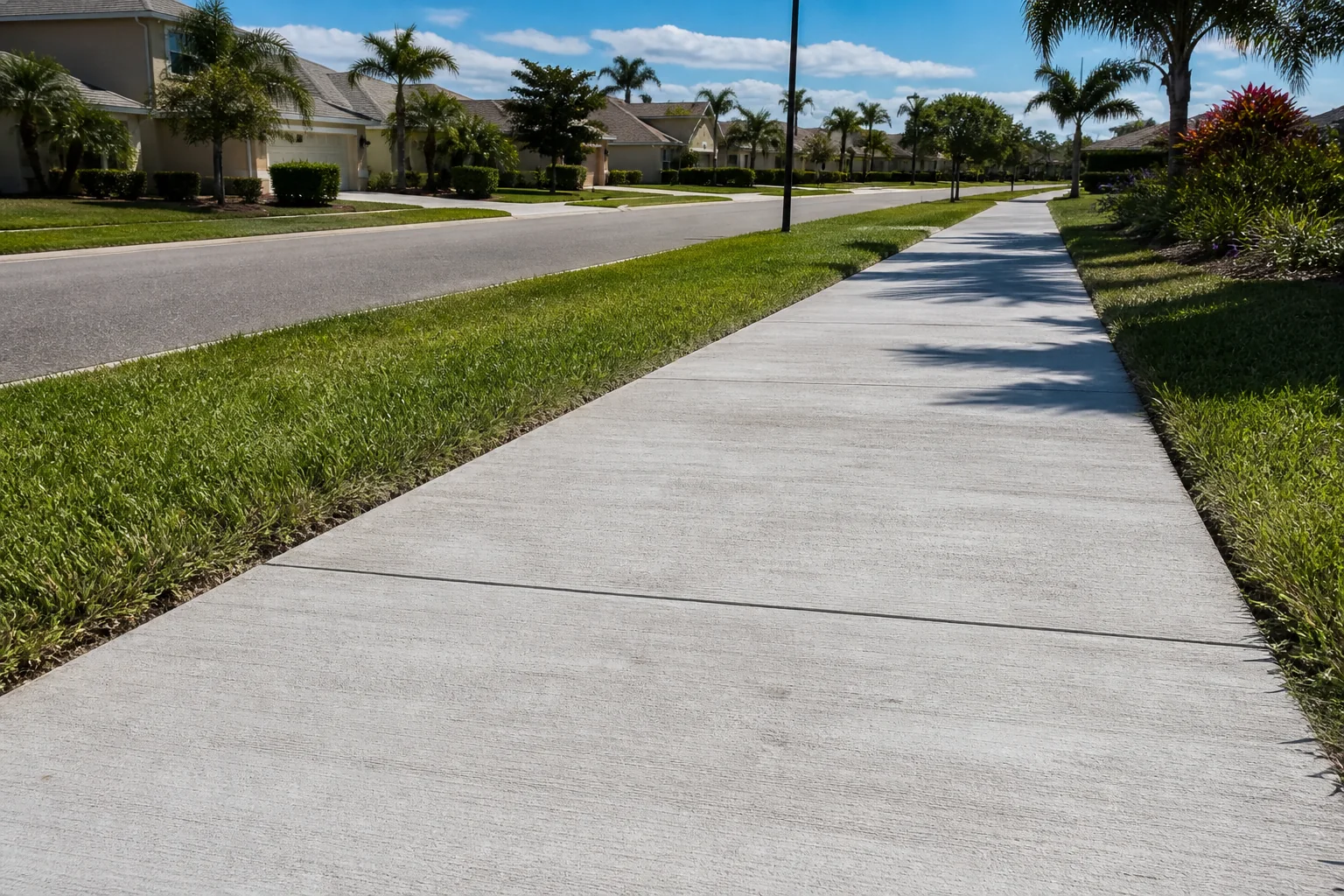
Illustrative images of concrete work we offer, not photographs of customer projects. Photos of our own finished jobs go up as they are documented.
How a project runs
From first call to final walkthrough
Every project follows the same path, so you always know which part you are in and what happens next.
- 01
Tell us about your project
Call or send the details — what the concrete is, what is wrong with it or what you want to add, and where the property is.
- 02
On-site evaluation
We come look at the actual concrete and the site around it: condition, drainage, access and how the space gets used.
- 03
Clear scope and estimate
You get the scope of work and the pricing in writing, so you know what is included before you decide anything.
- 04
Concrete work
Prep, forming, pouring and finishing, followed by the cure time the work needs before the surface goes back into use.
- 05
Final walkthrough
We walk the finished work with you, cover how to care for it early on, and answer whatever is left.
Where we work
Orlando and the surrounding Central Florida communities
Most of our work sits inside the Orlando metro and the communities around it, across Orange, Seminole, Osceola and Lake counties. If you are close to the edge of that, call and ask — it is a quick answer.
Communities we serve
- Orlando
- Winter Park
- Winter Garden
- Windermere
- Dr. Phillips
- Lake Nona
- Kissimmee
- Apopka
- Ocoee
- Oviedo
- Altamonte Springs
- Lake Mary
- Maitland
- Longwood
- Clermont
- St. Cloud
Nearby communities not listed here are often still within range.
Common questions
Questions we get asked before a project starts
Should I repair my concrete or replace it?
It depends on what is happening underneath. Surface-level cracking on a slab that is still sitting level and draining well can often be repaired or resurfaced. Concrete that has settled, lifted, cracked all the way through, or keeps failing in the same spot after patching usually points to a base problem, and replacement tends to be the better long-term call. Looking at it in person is the only reliable way to tell the difference.
How long does a concrete project take?
Timelines depend on the size of the pour, site access, how much existing concrete has to come out, and weather. The part homeowners most often underestimate is cure time — concrete needs time to gain strength after it is finished, and that window is separate from how long the crew is on site. We give you the expected schedule for your specific project with the estimate, including when the surface can be walked on and when it can take vehicles.
What concrete options do I have for a driveway, patio or pool deck?
Beyond a standard broom or smooth finish, there are stamped patterns, stained and integral color, exposed aggregate, and overlay or resurfacing systems that change the look of concrete that is still sound underneath. Each one differs in appearance, surface texture, upkeep and cost. For outdoor spaces here it is also worth talking through how a finish handles sun and moisture before choosing one.
Do you handle commercial work as well as residential?
Yes. Residential work covers driveways, patios, pool decks, walkways, slabs, and repair or replacement of existing concrete. Commercial work covers slabs, parking areas, sidewalks, curbs, dumpster and equipment pads, loading areas and warehouse or industrial floors. Commercial projects usually involve extra planning around keeping the property usable while work is underway.
How do estimates work?
Reach out with the details of your project and we will arrange to look at the site. Pricing concrete accurately means seeing the condition of what is there, the access for equipment, how the site drains and how much existing material has to be removed. You get the scope and the number in writing so there is nothing to interpret later.
What does concrete work cost in Orlando?
As a rough starting point for the Orlando area, a plain broom-finish driveway or slab often falls somewhere around $6 to $12 per square foot installed, and decorative finishes like stamped or exposed aggregate commonly run higher — very approximately $12 to $18 per square foot or more. Those are general market ranges for this area, not our quote, and the spread is wide for a reason. Removing and hauling away existing concrete, how much grading and base prep the ground needs, whether a truck can reach the pour or it has to be pumped, slab thickness, reinforcement, the finish you choose, drainage work and permit requirements all move the number. Sandy soils are common across Central Florida, so base preparation tends to be a real part of the job rather than a formality — a slab is only as good as what sits under it. The only way to get an accurate figure is to look at your site, and you get the scope and the number in writing before anything starts.
Is it better to resurface a pool deck or replace it?
It depends on what is actually failing. When the slab underneath is sound and the problem is the surface — worn texture, faded color, a coating that has given up — resurfacing is usually the shorter and less expensive route, and in this area that work often runs somewhere around $4 to $12 per square foot depending on the system and the condition of what is there. When a deck has settled, cracked through, or had repairs that keep failing in the same place, resurfacing covers the symptom while the cause keeps moving underneath, and replacement tends to be the better long-term call. Pool decks also take wear a driveway never sees: constant sun on the finish, splash-out and pool chemistry, which over time tends to break down sealers first and then work on the surface itself. Worth knowing that a lot of resurfacing advice comes from companies that only resurface. We would rather look at the deck and tell you which one you have.
Does concrete work in Florida require a contractor license?
Yes, and we are licensed and insured. Concrete flatwork — driveways, slabs, patios and similar poured work — falls under licensed specialty contracting in Florida, regulated by the Construction Industry Licensing Board under the Department of Business and Professional Regulation. Contractors are either state-certified, which allows work anywhere in Florida, or locally registered, which limits them to the jurisdiction that issued the registration. Ask any contractor you are considering for their license number and proof of insurance before you sign — DBPR publishes a free license lookup at myfloridalicense.com.
How does Orlando weather affect concrete work?
Two ways. During the work, summer heat affects how fast concrete sets while it is being placed and finished, and the rainy season affects scheduling. After the work, the bigger factors are drainage and sun. Water that collects against or under a slab, and constant UV on a decorative finish, are the conditions that show up over the following years — so both get planned for up front rather than treated as surprises.
Start your project
Tell us what you are working with
Send over the details of your driveway, patio, pool deck, parking area or floor and we will arrange to come look at it. You get the scope and the pricing in writing before anything gets scheduled.